
BLOGS
Cost of Living in Hoover AL vs Birmingham 2026 – Complete Breakdown
Real Estate, Cost of Living Hoover Alabama, Relocation Guide
Cost of Living in Hoover AL vs Birmingham — Full 2026 Comparison
Planning a move to the Birmingham metro and trying to decide between Hoover and the city of Birmingham itself? This 2026 guide breaks down the real cost of living in Hoover, Alabama versus Birmingham so relocation buyers can budget confidently and decide which lifestyle is the best fit.
Is Hoover Alabama Affordable? The Quick 2026 Answer
Is Hoover Alabama affordable? Hoover sits above the Alabama average for housing costs but significantly below national averages — and offers exceptional value when you factor in the quality of schools, safety, amenities, and Alabama's very low property taxes. Here's the full 2026 cost of living breakdown.
For many relocation buyers coming from Atlanta, Nashville, Chicago, New York/New Jersey, or California, Hoover feels like a financial “reset button.” Housing is more expensive than in the city of Birmingham, but day‑to‑day living costs stay comfortably below what you may be used to in larger metros or high‑tax states. The key is understanding where you’ll pay more, where you’ll pay less, and what you actually get for your money in Hoover versus Birmingham.
Housing Costs: Hoover vs Birmingham in 2026
Housing is where the biggest difference between Hoover and Birmingham shows up. By design, Hoover is a suburban community with newer neighborhoods, larger homes, and highly rated schools. Birmingham, by contrast, offers a wide mix of historic homes, smaller properties, and more urban neighborhoods at a much lower price point.
Home Purchase Prices
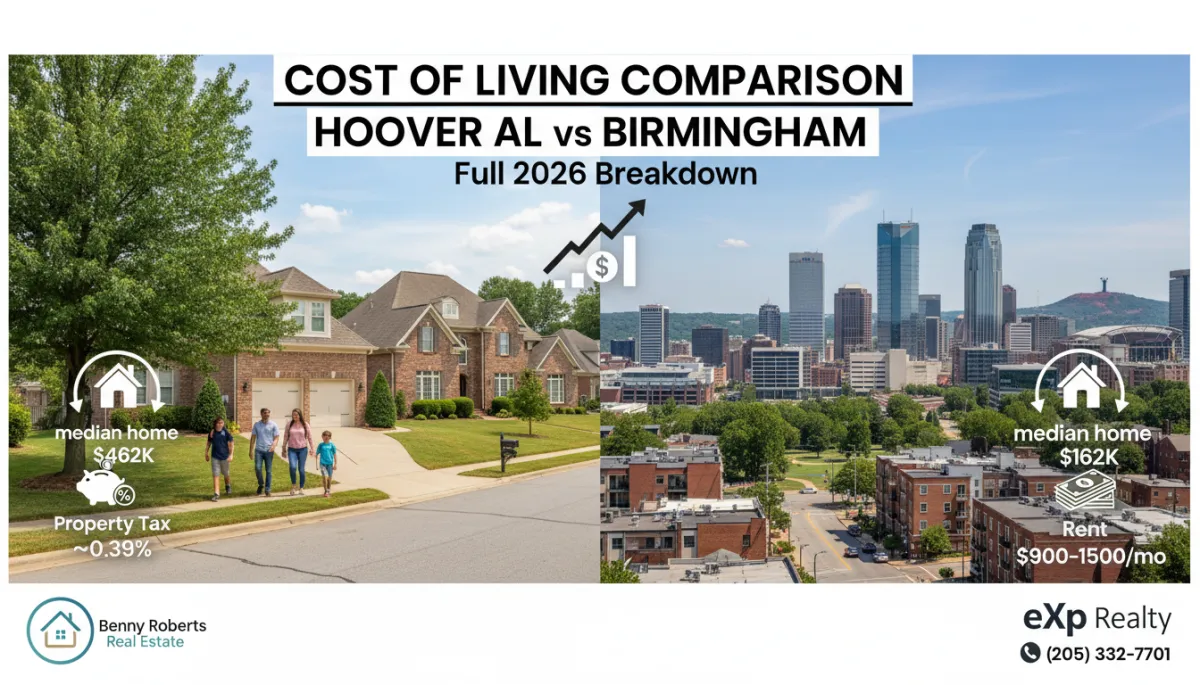
For this comparison, we’ll use a 2026 Hoover median home price of approximately $462,000. That lines up with recent sale data from major portals showing many Hoover homes trading in the mid‑$400s to low‑$500s. In contrast, the median home price in Birmingham sits around $160,000–$165,000, depending on the source, placing it dramatically below both Hoover and the national average.
On paper, that $462K vs. ~$162K gap looks huge. But it’s important to look beyond the sticker price:
- Home size: Hoover homes are typically much larger, often 2,500–4,000+ square feet, with multiple bedrooms, garages, and usable yards. Many Birmingham homes at the median price are smaller bungalows, older properties, or homes in areas still revitalizing.
- Schools: Hoover is widely known for its strong public school system, a major driver of demand and pricing. Birmingham City Schools are improving but remain more mixed, which is reflected in home values.
- Amenities & neighborhood feel: Hoover neighborhoods often include sidewalks, community pools, parks, and HOA‑maintained common areas. Birmingham offers many vibrant neighborhoods but fewer master‑planned suburban communities.
Rent in Hoover vs Birmingham
Renting is also more expensive in Hoover, but again, the product is different. As a general 2026 range:
- Hoover apartments: roughly $1,200–$2,000 per month, depending on size, age, and amenities. Newer Class A communities with pools, gyms, and garages sit at the upper end of that range.
- Birmingham apartments: roughly $900–$1,500 per month, with many options under $1,200, especially outside the most in‑demand neighborhoods.
For renters, the premium for Hoover often buys newer construction, quieter suburban surroundings, and top‑rated school zones — especially important if you’re relocating with children and want to “test‑drive” the area before buying.

Hoover homes cost more upfront but typically offer more space, newer builds, and stronger schools.
Property Taxes in Hoover AL: A Hidden Advantage
One of the biggest financial advantages of living in Alabama — and especially in Hoover — is how low property taxes are compared to most of the country. This is critical for relocation buyers coming from high‑tax states, where annual property tax bills can rival a mortgage payment.
Effective Property Tax Rates in Hoover
Alabama consistently ranks among the lowest property tax states in the U.S. Statewide, effective rates often fall in the 0.3–0.4% range. In the Hoover area specifically:
- Jefferson County (part of Hoover): effective rate around 0.39%.
- Shelby County (also part of Hoover): effective rate around 0.38%.
On a $462,000 Hoover home, that translates to roughly $1,800 per year in property taxes, or about $150 per month. Compare that to the national average effective rate of roughly 1.1%, which would produce a tax bill closer to $5,000 per year on the same‑priced home. For buyers coming from New Jersey, New York, Illinois, or California, where effective rates can reach 2–3% or more, the savings are even more dramatic.
Alabama State Income Tax & Overall Tax Burden
Alabama has a graduated state income tax ranging roughly from 2% to 5% of taxable income. While that’s not zero, the total tax burden for most households is still far below what you’ll see in the Northeast, upper Midwest, or on the West Coast — especially when you combine income, property, and sales taxes.
- No tax on Social Security income: Retirees benefit significantly, as Social Security benefits are not taxed at the state level in Alabama.
- Favorable treatment of many pensions: Certain pension and retirement accounts receive preferential tax treatment, helping keep retirement income in your pocket.
- Overall tax burden: When you combine modest income taxes with very low property taxes, many relocating households see a significant net tax savings by moving to Hoover from high‑tax states.
Utilities: What to Expect from Alabama Power & Local Providers
Utility costs in Hoover and Birmingham are broadly similar, since both draw from the same providers. The main difference is often home size and efficiency — larger Hoover homes may cost more to heat and cool, but modern construction can help offset that with better insulation and newer systems.
- Electricity (Alabama Power): For a typical single‑family home, expect around $150–$200 per month in the summer when air conditioning runs heavily, and roughly $80–$130 per month in milder spring and fall months, depending on home size and habits.
- Water (Birmingham Water Works): Rates are generally modest by national standards. A family of four can often stay in the $40–$70 per month range, depending on irrigation and usage.
- Natural gas (Spire): Used primarily for heating, cooking, and water heaters. Bills are typically lower than electricity and remain competitive compared to other states.
Overall, utilities in Hoover are close to or slightly below the national average, with the biggest driver being summer air conditioning. Efficient systems, ceiling fans, and smart thermostats can meaningfully reduce your monthly bills.
Groceries & Everyday Shopping in Hoover
One of the pleasant surprises for many relocation buyers is how reasonable grocery and household costs are in Hoover. The city offers a wide range of shopping options, including:
- Publix and Kroger for everyday grocery runs
- Walmart and Costco for bulk savings and general merchandise
- Whole Foods and Trader Joe’s for organic and specialty items
Across these stores, grocery costs in Hoover typically run about 5–10% below the national average. That means your weekly food budget can stretch a bit further than in many coastal or large metro areas, especially if you take advantage of sales, store brands, and warehouse clubs.

Hoover’s mix of Publix, Costco, and specialty grocers keeps food budgets manageable for families.
Healthcare Access & Costs Near Hoover
For many relocating families, healthcare access is just as important as housing. Hoover residents benefit from being within a short drive of some of Alabama’s best medical facilities:
- UAB Medical Center: A nationally recognized academic medical center located about 20–30 minutes away in downtown Birmingham, depending on traffic and your exact neighborhood in Hoover.
- Grandview Medical Center: A modern hospital on U.S. 280, also roughly 20–30 minutes from much of Hoover, offering a wide range of specialties and outpatient services.
Overall, healthcare costs in Alabama tend to run below national averages, especially compared to high‑cost states. Insurance premiums will depend on your employer and plan, but out‑of‑pocket costs for common services and procedures are often noticeably lower than in major coastal metros.
Transportation, Commuting, and HOA Fees
Both Hoover and Birmingham are car‑dependent markets. Public transit exists but is limited, and most residents rely on personal vehicles for commuting, errands, and school drop‑offs. When you’re calculating the cost of living in Hoover Alabama, transportation should be part of the picture.
- Gas prices: Typically run below the national average, which helps offset the need for daily driving. Alabama often benefits from lower fuel taxes than many other states.
- Auto insurance: Rates vary widely based on driving history, vehicle type, and coverage. It’s important to shop around, as premiums can differ significantly between carriers.
- HOA fees: Many Hoover neighborhoods are part of homeowners associations. Fees can range from about $50 to $500 per month depending on whether the community offers amenities like pools, clubhouses, gated access, or lawn maintenance. Birmingham has HOAs as well, but fewer large master‑planned communities.
While HOA fees are an added monthly cost, they often cover amenities that would cost more to replicate on your own — and they can help protect property values over time, which matters for long‑term homeowners.
Dining, Shopping & Entertainment: Everyday Lifestyle Costs
Dining and entertainment in Hoover and Birmingham are significantly less expensive than in major metro areas like Atlanta, Chicago, or Los Angeles. You can enjoy a comfortable, active lifestyle without the high “big city” price tag.
- A nice dinner out for two at a sit‑down restaurant in Hoover typically runs around $50–$100 per couple, including entrées and drinks but not an extravagant wine list. Casual meals are even more affordable.
- The Riverchase Galleria and Patton Creek shopping centers offer mainstream retail at standard national pricing, plus plenty of fast‑casual and full‑service dining options.
- Entertainment costs — movies, youth sports, fitness memberships, local events, and attractions — are generally very affordable by national standards. Many families find they can say “yes” to more activities without stretching the budget.
How Hoover Compares to Popular Relocation Origins
If you’re researching the moving to Hoover Alabama cost, it helps to compare Hoover not just to Birmingham, but also to the cities many buyers are leaving. Here’s a high‑level look at how Hoover stacks up in 2026.
Hoover vs Atlanta
Compared to metro Atlanta, Hoover generally offers significantly cheaper housing and lower taxes. Many Atlanta suburbs with top schools now have median prices equal to or higher than Hoover, but Georgia’s property taxes and overall tax burden tend to be higher. Traffic and commute times are also typically lighter in Hoover than in Atlanta’s core suburbs.
Hoover vs Nashville
Housing prices in Hoover and greater Nashville can be comparable in many cases, especially in desirable school zones. The major difference is taxes: Alabama’s property taxes are much lower than Tennessee’s in many suburban areas. Day‑to‑day costs like groceries and dining are similar or slightly lower in Hoover, and traffic is far less intense.
Hoover vs Chicago (and the Midwest)
From Chicago and many Midwestern metros, Hoover is dramatically cheaper across the board when you factor in:
- Lower housing costs for similar suburban homes
- Much lower property taxes and often lower income taxes
- Reduced heating costs thanks to milder winters
Many Midwestern relocation buyers find that Hoover allows them to upgrade their home and lifestyle while lowering their overall cost of living.
Hoover vs New Jersey / New York
For households leaving New Jersey or the New York metro area, Hoover is a true financial relief valve. Even though Hoover home prices are high by Alabama standards, they are often far lower than what you’d pay in many Northeast suburbs — and the property tax difference alone can free up thousands of dollars per year. Everyday items, dining, and services also tend to cost less, without sacrificing quality of life.
Hoover vs California
Compared to California, the difference is night and day. A $500,000 home in Hoover might equate to a much smaller condo or townhome in many California markets. Gas, groceries, insurance, and taxes are all typically lower in Hoover. For remote workers or retirees, moving from California to Hoover can dramatically reduce monthly expenses while still providing access to good schools, healthcare, and amenities.
Annual Cost of Living in Hoover: Family of Four Example
To put all of these pieces together, let’s look at a ballpark annual budget for a family of four living in Hoover in a $500,000 home. Actual numbers will vary based on lifestyle, but this provides a realistic planning range.
- Mortgage (principal & interest): Highly dependent on down payment and rate, but many families will fall in the $24,000–$36,000 per year range.
- Property taxes: On a $500,000 home at Hoover’s low effective rates, roughly $1,900–$2,000 per year.
- Homeowners insurance & HOA fees: Varies widely, but many families may spend $2,000–$6,000 per year combined, depending on coverage and community amenities.
- Utilities (electric, gas, water, trash, internet): Often in the $4,000–$6,000 per year range for a typical family home.
- Groceries & household items: A moderate family budget might run $8,000–$12,000 annually, depending on where you shop and how often you dine out.
- Transportation: Fuel, maintenance, and insurance for two vehicles can easily reach $6,000–$10,000 per year, influenced by commute distance and vehicle type.
- Dining, entertainment, kids’ activities, and extras: This is where lifestyle choices matter most, but many families in Hoover fall somewhere between $8,000 and $18,000 per year.
Taken together, a reasonable total annual cost of living in Hoover for a family of four in a $500K home lands roughly between $65,000 and $90,000, depending on mortgage structure and lifestyle. That range provides a helpful benchmark when comparing Hoover to your current city.
FAQ: Cost of Living Hoover Alabama & Taxes
Is Hoover Alabama expensive?
By Alabama standards, Hoover is on the higher end for housing costs, especially compared to the city of Birmingham. However, when you compare Hoover to national averages and to many relocation markets, it is moderately priced — and the combination of strong schools, low crime, and low property taxes makes it feel like a solid value rather than “expensive” for what you get.
Is Alabama a cheap state to live in?
Overall, yes. Alabama consistently ranks among the more affordable states in the country. Housing, property taxes, and many everyday expenses are below national averages. Even in higher‑priced communities like Hoover, the overall cost of living remains attractive compared to many other states, especially those with high taxes or coastal housing premiums.
What are property taxes in Hoover AL?
Property taxes Hoover AL are among the most appealing aspects of living here. Effective rates in the Hoover area generally run around 0.38–0.39%. On a typical Hoover home priced around $462,000, you might expect a tax bill of roughly $1,800 per year, much lower than the U.S. average and dramatically lower than many Northeast, Midwest, and West Coast markets.
Is Hoover AL affordable?
Hoover AL is affordable for many relocation buyers, especially those coming from higher‑cost states or large metros. While home prices are higher than in Birmingham, the combination of low property taxes, reasonable utilities, below‑average grocery costs, and moderate lifestyle expenses means many families can enjoy a high quality of life without stretching their budget to the breaking point.
How does Hoover AL compare cost of living to Atlanta?
When you compare the Hoover AL vs Birmingham cost of living, Hoover is higher. But compared to Atlanta, Hoover often looks like a bargain. Housing in desirable Atlanta suburbs can be as expensive or more expensive than Hoover, while Georgia’s property taxes and overall tax burden tend to be higher. Daily costs like gas, groceries, and dining are similar or slightly lower in Hoover, and commute stress is usually less intense.
Ready to Explore Homes and Real Numbers for Your Move?
Every relocation story is different. Your cost of living will depend on your income, desired neighborhood, school needs, and lifestyle. Working with a local expert who understands both the numbers and the neighborhoods is the best way to make a confident decision about whether Hoover AL is affordable for your family.
Ready to make the move to Hoover? Get personalized guidance on neighborhoods, property taxes, HOA structures, and the true moving to Hoover Alabama cost for your situation.
Call Benny Roberts with eXp Realty at (205) 332-7701 or visit BennyRoberts.com to start your Hoover home search and cost‑of‑living planning today.

Local guidance helps relocation buyers match their budget to the right Hoover neighborhood.

PROCESS

BUYER'S PROCESS
Finding and making an offer on the right house can be complicated….and it just gets more involved as you move through the inspection, appraisal, and financing phases of the purchase. I specialize in streamlining these processes to make your experience as smooth as possible.
BUYER’S FAQs
What do I need to do before I start looking for a home?
You will first need to contact a lender and obtain a financing pre-approval letter. This will help you know how much you can afford and will help us tailor our search in finding your next home! Additionally, many sellers require that a preapproval letter accompany the offer or be submitted quickly after the offer is accepted, so it makes sense to already have one ready!
What happens after my offer is accepted?
Acceptance of the offer is only the beginning! Once your offer is accepted by the seller, the home inspection, septic (if necessary) inspection, and appraisal will all take place. I will help you understand and negotiate through each step as you get closer to closing day.
What is Earnest Money?
Earnest money is a “good faith deposit” that you put down once your offer is accepted. This money is usually held by the Seller’s broker in a non-interest bearing escrow account. If you decide not to move forward with the purchase due to contingencies outlined in the contract, the seller will release the earnest money back to you. Both parties must agree to release the earnest money.
What are closing costs and who pays for them?
Closing costs are the fees and costs that are associated with finalizing or “closing” the sale of your property. Closing costs include (but are not limited to) the appraisal fee, lender fees (such as credit report fee, loan origination fee, flood certification fees, and underwriting fees), taxes, title fees, and insurance. This is another reason to talk to a lender prior to looking for a home. Your lender will be able to take all of these extra items into account when you are deciding how much you can spend. Some closing costs are paid by the seller and some are paid by the buyer. The contract will determine who pays for what costs. It is not uncommon for buyers to ask sellers to pay for a portion of the closing costs.
SELLER'S PROCESS
Selling your home can be a daunting task. Valuing your home, getting it ready to show, managing the showing process, and negotiating offers is time consuming and can be complicated. I take care of all aspects of helping you navigate the process successfully.
Listing & Marketing
As I’m pricing and staging your home, I also develop a strategic marketing plan to target the right prospective buyers. Your home will have immediate interest and activity via inclusion in the multiple listing service (MLS) and on websites such as Zillow, Trulia, and Realtor.com. However, I take additional measures to make sure your listing gets highlighted to Realtors who have active buyers in your area. I have a very broad network and I send out targeted texts, emails, and/or phone calls in order to contact the right people with the right information. I work to create urgency and competition amongst qualified prospects so you can have the best chances at getting offers from qualified and competitive buyers.
Analyzing & Negotiating
Once you have started fielding offers, I diligently review them and help you analyze and understand the key terms. I carefully work with you to formulate a well-supported counter offer so that your price and terms are the very best possible.
Closing
I understand the stress and logistics of selling your home. My goal is to help you coordinate all the pieces of the closing and follow through on them so your process can be as stress free as possible. I work diligently with lenders and other vendors to help you close seamlessly and on time.
SELLER'S FAQs
What is the most important factor in selling?
Optimized pricing – Even in a seller’s market, if your home isn’t priced correctly, it will likely sit on the market. Homes that sit on the market for an extended time tend to lose momentum. I will provide you the tools and advice to prevent this from happening.
How do I value my home?
Recent comparable transactions is the primary item. I will gather and analyze the data to help you optimize the list price of your home. Two of the most important factors in selling your home are price and condition. I understand how to properly value your home and can price your home based on the market, your needs, and timeline. I will also advise you on how to stage your home to maximize appeal.
What do I need to do before I put my house on the market?
The first step that everyone needs to do is to declutter. Even the neatest of homes has the occasional closet or corner that could use a little organization. Buyers will be looking at every corner of your home, so make sure it’s ready to show!
Secondly, you will need to make sure your home is very clean. If a home isn’t well kept, buyers can focus on the dirt and won’t see the other features.
Finally, stage your home to sell. I am experts at this and would love to help you! Sometimes furniture rearrangements and accessorizing with item such as good lighting can do wonders to homes attractiveness. Remove excess personal photos and personal items, streamline countertops, and remove items that you don’t use every day. Open and clean space help home’s appeal to buyers.
Past Clients









Raving Fans
Bottom Line:
We are going to get the job done properly for you and not let you down. Period.
There is no risk and no obligations, just expert and friendly advice!