Cash Offer vs Traditional Sale in Hoover AL 2026
Real Estate, Cash Offer vs Traditional Sale Hoover AL
Cash Offer vs. Traditional Sale in Hoover AL — What Sellers Need to Know in 2026
If you own a home in Hoover, you are likely seeing postcards, texts, and online ads from cash buyers and iBuyers promising an “easy sale.” In a 2026 market where Hoover home values hover in the mid-$400s and inventory still leans in favor of sellers, understanding the real trade‑offs of a cash offer vs traditional sale in Hoover AL is critical to protecting your equity.

What a Cash Offer Really Means in 2026
At its core, a cash offer simply means the buyer is not using a mortgage. There is no financing contingency, so the buyer does not need lender approval, underwriting, or an appraisal for loan purposes. That is why national data from the National Association of Realtors shows cash buyers are increasingly active as rates stay elevated into 2026.
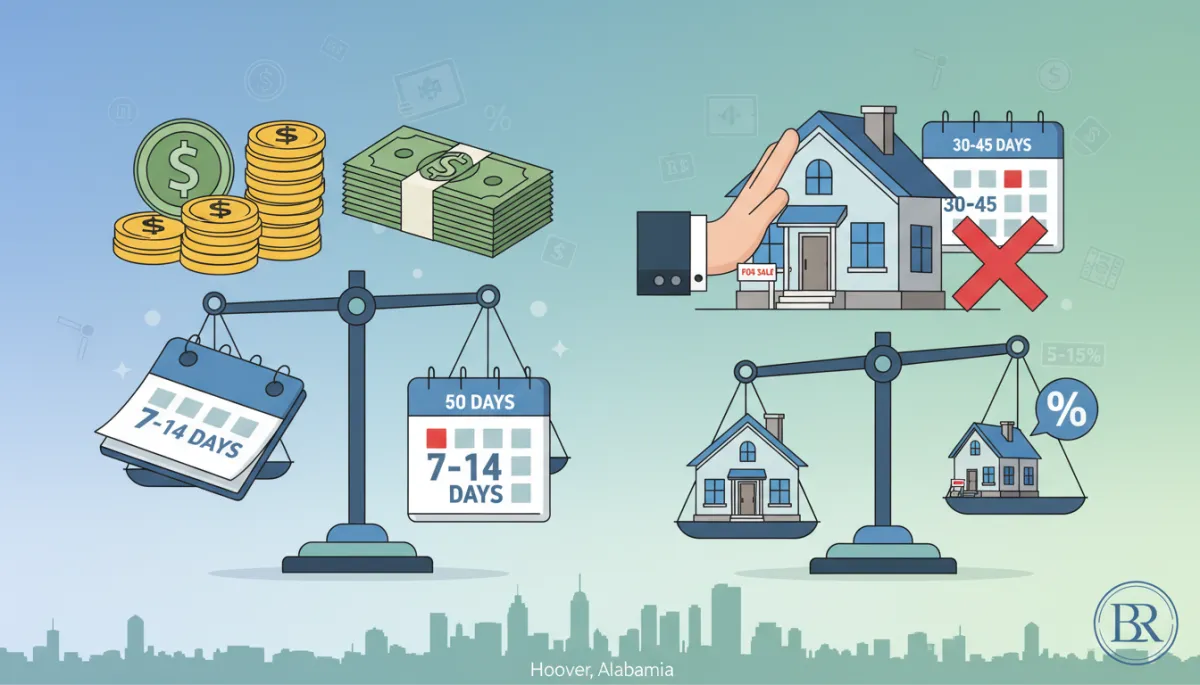
Practically, this changes your timeline. A typical financed sale in Hoover runs about 30–45 days from contract to closing to allow for loan processing, appraisal, and final approval. A true cash buyer can often close in 7–14 days, sometimes even faster if title work is straightforward and the property is vacant. That speed and certainty are what you are being asked to pay for when you sell home cash buyer Birmingham Alabama 2026 or in the Hoover sub‑markets.
When Taking a Cash Offer Is Actually Worth It
Despite the marketing hype, cash is not automatically “better.” It becomes powerful only when the time savings or certainty solve a real problem for you. Here are situations where a discounted cash offer can make financial sense:
- You need speed to access equity. If you are already under contract on a new construction home or relocating for a job and a delayed sale could cost you thousands in penalties or lost opportunities, shaving weeks off the timeline may justify a discount.
- Probate or estate sale. When multiple heirs are involved, a drawn‑out listing can create conflict and ongoing carrying costs. A clean, quick cash sale can simplify division of proceeds and reduce stress during an already emotional process.
- Condition or appraisal problems. If the home has serious deferred maintenance, structural issues, or safety concerns that would likely cause a lender’s appraiser to flag the property, traditional buyers may not be able to close even if they love it. Investors paying cash will often buy “as‑is,” absorbing repairs and risk in exchange for a discount.
In these scenarios, the question is not “Is cash good or bad?” but “What is the cost of waiting or fixing?” That is where clear math protects you from emotional decisions.
When Cash Offers Lose: The Convenience Premium in Hoover
In a steady 2026 Hoover market—where median sale prices are in the $450K–$480K range and well‑priced homes still attract solid buyer activity—most investors and iBuyers are not paying top dollar. They are running spreadsheets. For many Hoover sellers, most cash offers land about 5–15% below realistic market value. That gap is your “convenience premium.”
Even a 5–10% discount on a Hoover home can erase tens of thousands in equity.
On a $450,000 home, a 10% discount is $45,000. If your holding costs (mortgage, taxes, insurance, utilities, lawn care) run $2,000 per month, you would need more than 22 months of extra carrying time to justify that discount purely on timeline. In a city where median days on market are under two months, that math rarely favors the investor’s first offer. This is why the question should I take cash offer Alabama must always be answered with numbers, not fear of “missing out.”
How to Compare Net-to-Seller: Cash vs Financed Offers
To truly compare a cash offer vs traditional sale Hoover AL, you must look past the headline price and calculate net-to-seller. Here is a simple framework you can use with any offer:
- Start with contract price. Write down the cash price and the financed price separately.
- Subtract seller‑paid costs. This includes commissions, any agreed closing cost credits, and typical seller fees (title, recording, etc.). Make sure you apply the same assumptions to each offer so the comparison is apples‑to‑apples.
- Add or subtract repair items. If the cash buyer is taking the home as‑is, but the financed buyer is requesting $7,000 in repairs or a credit, reflect that difference in your net.
- Factor in carrying costs for extra time. Estimate your monthly cost to own the property (mortgage, taxes, insurance, utilities, HOA). Multiply that by the likely closing timeline: 1–2 weeks for cash vs 4–6 weeks for financing. The difference is the true “time cost.”
In many real‑world Hoover scenarios, sellers discover that a financed buyer at full price, even with slightly higher fees and a longer timeline, still nets $15,000–$40,000 more than the quick‑close investor. Once you see that on paper, the “easy button” looks a lot more expensive.
The Hybrid Option: Strong Conventional Buyers That Act Like Cash
There is a middle ground many Hoover sellers overlook: well‑qualified conventional buyers with large down payments. These buyers are often putting 20–30% down, are fully pre‑approved, and can move quickly because their lender has already reviewed income, assets, and credit before they make an offer.
With the right lender, these buyers can sometimes close in as little as 21 days, only a week or two slower than many cash transactions. Yet they typically pay full market price or close to it, especially in desirable Hoover neighborhoods. For you as the seller, this “hybrid” path can deliver:
- A strong price, often at or above list
- Reasonable closing timeline, close to cash speed
- The security of a serious, invested buyer with real skin in the game
When you evaluate offers, do not lump every financed buyer into the same “slow and risky” bucket. A strong conventional buyer with a significant down payment is often nearly as reliable as cash—and far better for your bottom line.
Benny’s Approach: Objective, Math-First Offer Evaluation
Benny’s role is not to push you toward or away from cash, but to protect your equity by putting every option under the same bright light. When a Hoover or Birmingham homeowner asks, “should I take cash offer Alabama buyers are pitching me?” Benny walks through a consistent, analytical process:
- Clarify your priorities. Do you value maximum price, fastest close, minimal showings, or some combination? Your goals drive the recommendation.
- Estimate true market value. Using current Hoover 2026 data from sources like Zillow, Redfin, and the local MLS, Benny establishes a realistic price range for a traditional listing—not a wishful number, but what buyers are actually paying.
- Run side‑by‑side net sheets. For each offer type—cash, conventional, FHA/VA—he calculates net‑to‑seller, including concessions, repairs, fees, and estimated carrying costs based on likely timelines.
- Stress‑test the risks. What happens if the appraisal comes in low? What if rates tick up and a buyer gets cold feet? What if you accept a low cash offer and the property resells in 60 days for $40,000 more? Seeing those scenarios in advance helps you avoid regret.
Only after the numbers are clear does Benny talk strategy—whether that is listing traditionally, negotiating a better cash price, or targeting strong hybrid buyers who can move quickly without demanding a deep discount.
Protect Your Equity Before You Decide
In 2026, Hoover and greater Birmingham remain fundamentally healthy markets. That means you have options—and that a quick cash check could easily cost you five figures if you do not run the math. Before you sign anything from an investor, iBuyer, or traditional purchaser, get an objective, numbers‑driven review of every path available to you.
To schedule a no‑pressure strategy session and see your personalized net‑to‑seller breakdown for cash, traditional, and hybrid offers, visit bennyroberts.net/book-seller. One clear conversation today can protect years of hard‑earned equity tomorrow.


